
The Patient We All Know
Picture a 54-year-old man — professionally successful, no symptoms, feeling entirely well. His physician diagnosed him with hypertension two years ago. He was prescribed an ACE inhibitor, advised on lifestyle modifications, and discharged with a follow-up appointment in three months. He filled the prescription. He started the medication.
But six months later, he missed a week of doses during a work trip. Then he occasionally forgot the morning pill. Then, gradually, the tablet moved from the bedside table to the back of the drawer.
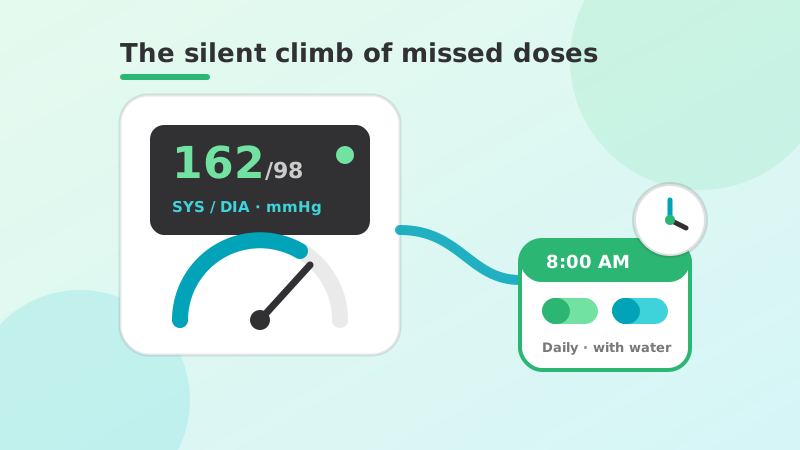
His blood pressure, unbeknownst to him, had climbed back to 162/98 mmHg.
He had no symptoms. He felt fine.
Three weeks later, he was admitted with an acute ischaemic stroke.
This is not a rare or extreme scenario. This is, in clinical terms, the most predictable outcome of a deeply underappreciated public health failure — medication non-adherence in hypertension.
What Is Medication Non-Adherence? A Clinical Definition
Medication adherence is broadly defined as the extent to which a patient's medication-taking behaviour corresponds with the agreed recommendations of their healthcare provider. The World Health Organization operationalises adequate adherence as consuming 80% or more of prescribed doses within a given timeframe.
Non-adherence is not simply a matter of forgetting a pill. It exists on a spectrum:
- Primary non-adherence — the prescription is written but never filled
- Secondary non-adherence — the medication is dispensed but not consistently taken
- Discontinuation — therapy is abandoned entirely, often without informing the prescribing physician
In hypertension specifically, all three patterns are prevalent and clinically consequential. What unites them is a shared outcome: blood pressure that remains inadequately controlled despite an effective pharmacological strategy sitting in the patient's cabinet.
The Scale of the Problem: Why This Matters Globally
Hypertension affects over 1.3 billion people worldwide and remains the single most significant modifiable risk factor for cardiovascular disease, stroke, and premature death. We have effective, well-tolerated medications. We have clear treatment targets. We have decades of evidence.
And yet, blood pressure control rates globally remain unacceptably poor.
The reason is not the medication. The reason is that it is not being taken.
Evidence from multiple studies indicates that between 50% and 80% of patients treated for hypertension are non-adherent to their antihypertensive regimen — a figure that holds even among patients who have already experienced a cardiovascular event. Antihypertensive therapy, when taken correctly, reduces the risk of stroke by approximately 30% and myocardial infarction by approximately 15%. These are not marginal benefits. They are life-altering reductions in catastrophic events.
The gap between what the medication can do and what it does is the gap created by non-adherence.
The Clinical Consequences: Blood Pressure Is Not Forgiving
There is a biological reality that clinicians must convey clearly to their patients: the cardiovascular system responds to blood pressure in a continuous, dose-dependent fashion.
For every rise of 20 mmHg in systolic blood pressure and every 10 mmHg rise in diastolic blood pressure above optimal levels, the risk of stroke and ischaemic heart disease approximately doubles. Blood pressure is not a number that can be selectively managed on convenient days.
When a hypertensive patient misses doses — even intermittently — the pharmacological protection is withdrawn. Blood vessels remain under chronic mechanical stress. Left ventricular hypertrophy progresses silently. Arterial stiffness worsens. Endothelial dysfunction deepens. None of this produces symptoms in the short term. All of it accumulates toward an event.
Organ-Specific Consequences of Uncontrolled Hypertension Due to Non-Adherence
Cerebrovascular: Persistent hypertension accelerates atherosclerosis in both large and small cerebral vessels. Lacunar infarcts — small, strategically devastating strokes — are disproportionately associated with chronic hypertensive damage to penetrating arteries. Non-adherence removes the single most effective pharmacological protection against this pathway.
Cardiovascular: The heart adapts to sustained pressure overload through concentric hypertrophy — a process that increases myocardial oxygen demand, impairs diastolic filling, and creates arrhythmogenic substrate. Over years, this translates into heart failure, atrial fibrillation, and sudden cardiac death.
Renal: The kidney is both a cause and a victim of hypertension. Uncontrolled blood pressure accelerates glomerular injury, promotes proteinuria, and drives progression toward chronic kidney disease. In patients with pre-existing renal impairment, non-adherence can hasten the trajectory toward end-stage renal disease.
Retinal: Hypertensive retinopathy is irreversible at advanced stages. It is one of the few places in clinical medicine where we can directly visualise vascular damage — and what we see in the fundus reflects what is happening in cerebral and coronary vessels simultaneously.
The Hidden Clinical Reality: Pseudo-Resistant Hypertension
This is a concept that deserves far more attention in clinical practice than it currently receives.
A significant proportion of patients labelled as having resistant hypertension — defined as blood pressure that remains above target despite three or more antihypertensive agents, including a diuretic — do not, in fact, have true pharmacological resistance. Their blood pressure is uncontrolled because their medications are not being taken consistently.
Studies examining adherence in patients with presumed resistant hypertension have identified non-adherence as a critical — and reversible — contributor to the clinical picture. When adherence is verified through objective monitoring and adequately supported, a substantial number of these patients achieve blood pressure control without any change in their regimen.
This has profound implications. Clinicians who do not systematically assess adherence before escalating therapy risk adding medications that carry side effect burdens, drug interactions, and costs — all in response to a problem that is fundamentally behavioural, not pharmacological.
Why Patients Don't Take Their Medication: Beyond the Obvious
It is tempting to reduce non-adherence to simple carelessness or poor motivation. This is both clinically inaccurate and counterproductive. Non-adherence in hypertension is a multifactorial phenomenon driven by a convergence of patient, physician, and system-level factors.
Forgetfulness remains the most commonly cited reason. One well-designed study found that nearly 50% of patients identified forgetfulness as their primary reason for missing doses. This is a behavioural reality of managing a chronic, asymptomatic condition: there is no pain to remind the patient, no visible deterioration to motivate action.
The asymptomatic nature of hypertension is itself a profound barrier. Patients do not feel hypertensive. They feel well. The cognitive dissonance between feeling healthy and being asked to take daily medication indefinitely — medication that sometimes causes dizziness, fatigue, or other side effects — is a genuine psychological obstacle that rational non-adherence theory describes as entirely predictable.
Side effects are a significant and often under-addressed contributor. In one study of hypertensive patients, adverse effects were listed as the most common concern among those who were non-adherent to their antihypertensive medication. Patients weigh perceived harm against perceived benefit constantly. If no one explains what the medication is doing and why it matters, the scales tip toward discontinuation.
Polypharmacy and regimen complexity compound the problem substantially. Data show a near-linear relationship between the number of daily medications and the degree of non-adherence. Patients taking ten or more daily medications demonstrate adherence rates as low as 20%. Each additional pill added to a regimen without a corresponding improvement in adherence support is, to some degree, a clinical risk.
Communication failure between patient and physician is a structural contributor that the literature consistently identifies but clinical practice consistently underestimates. A physician who does not ask how a patient is taking their medication — specifically and non-judgementally — cannot know the answer. And without that knowledge, clinical decision-making is built on an inaccurate premise.
Psychosocial factors including depression, health literacy, financial constraints, and lack of social support create layers of vulnerability that no prescription pad can address alone.
What the Evidence Tells Clinicians: Practical Strategies
Addressing non-adherence requires a structured, multi-pronged approach. It cannot be delegated to a single intervention or left to the patient to resolve.
Simplifying the Regimen
There is robust evidence that reducing dosing frequency improves adherence. Once-daily dosing consistently outperforms twice-daily regimens, which in turn outperform three- and four-times-daily schedules. Where clinically appropriate, fixed-dose combination antihypertensives — combining two or more agents in a single tablet — have demonstrated meaningful improvements in adherence rates. A meta-analysis of over 20,000 patients found a 26% reduction in non-adherence associated with fixed-dose combinations.
Structured Patient Education
Patients who understand why they are taking a medication, what it is doing, and what happens if they stop are better equipped to adhere. This is not a matter of lecturing. It is a matter of translating pharmacology into lived meaning. The teach-back method — asking patients to explain the medication's purpose in their own words — is a simple, validated tool for confirming comprehension.
Physician Communication and the Therapeutic Alliance
There is quantitative evidence that the quality of physician-patient communication directly influences adherence. Patients who feel that their concerns are heard, their treatment decisions are shared, and their barriers are acknowledged demonstrate significantly higher adherence rates. Asking directly and non-judgementally — "How often would you say you miss a dose?" — opens a clinical conversation that can meaningfully change outcomes.
Motivational Interviewing
Motivational interviewing, a structured counselling approach designed to resolve ambivalence and build intrinsic motivation, has demonstrated significant benefit in improving medication adherence in hypertension management. A meta-analysis of 72 randomised controlled trials showed significant benefit for blood pressure and cholesterol control through this approach. It requires training, but even brief motivational conversations at routine visits can influence behaviour.
Addressing the Timing Problem
For many patients, the barrier is not unwillingness but disorganisation. Daily life is complex. Routines are disrupted by travel, shift work, illness, and family demands. The clinical literature consistently identifies timing consistency as a distinct adherence variable — separate from simply whether the medication was taken at all. Irregular timing of antihypertensives can lead to subtherapeutic troughs in plasma drug concentration, defeating the purpose of a well-designed dosing strategy.
This is where structured environmental supports become clinically relevant. Linking medication-taking to a fixed daily routine — morning coffee, a meal, bedtime — is a low-cost behavioural strategy. For patients who need more reliable support, purpose-designed reminder tools and intelligent medication management systems can serve as practical scaffolding. Smart medication adherence devices — systems that alert patients at the prescribed time, track whether doses have been taken, and flag missed doses — represent a meaningful technological adjunct for patients managing complex regimens or with demonstrated adherence challenges. Tools in this category, such as Kiron from Caretron, approach the problem not as a surveillance mechanism but as a supportive system: bridging the gap between the prescription and the patient's daily routine.
A Note on Clinical Assessment
Before escalating antihypertensive therapy in any patient with inadequately controlled blood pressure, non-adherence must be systematically considered and assessed. Tools such as the 8-item Morisky Medication Adherence Scale (MMAS-8) — validated specifically in hypertensive populations — offer a structured, non-judgemental framework for identifying patients at high risk of non-adherence. Pharmacy refill records, where accessible, offer a practical objective proxy.
The clinical question is never "Is this patient non-compliant?" The clinical question is "What are the specific, modifiable barriers that are making it difficult for this patient to take their medication consistently?" This reframing changes the conversation — and often changes the outcome.
Conclusion: The Pill on the Bedside Table
Every day, across every country, there are millions of antihypertensive tablets that are prescribed, dispensed, and not taken. Each one represents a small but non-trivial increment in vascular risk — risk that accumulates quietly, invisibly, until it does not.
Hypertension is a disease without a voice. It does not announce itself. It does not cause pain. It does not produce the kind of urgency that motivates daily action in the way that a visible wound or an acute illness does. Managing it requires a sustained, deliberate act of health behaviour that we ask patients to maintain for decades — often without adequate support, education, or practical infrastructure.
Our role as clinicians extends beyond writing the prescription. It extends to understanding why patients do not take it, addressing those barriers with the same rigour we apply to pharmacological selection, and building care systems that make adherence easier rather than assuming it is guaranteed.
The evidence is clear. The medication works. The gap is the behaviour. And the behaviour can be changed.